
Events
NDMC Talk Series: Invited Talks by Prof. Caroline Buckee, Harvard University and Dr. Prashanth Selvaraj, Institute of Disease Modeling, Gates Foundation
October 22, 2026
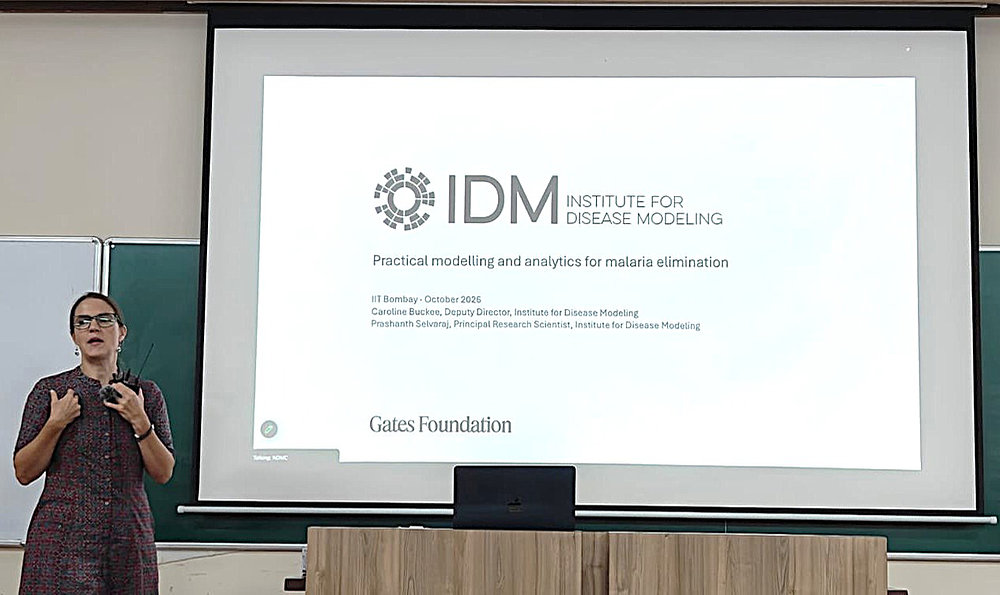
Prof. Caroline Buckee from the Department of Epidemiology at Harvard University, and who serves as the Deputy Director of Institute for Disease Modeling, Gates Foundation, and Dr. Prashanth Selvaraj, Principal Scientist, Institute for Disease Modeling, Gates Foundation delivered a talk about practical modelling and analytics for malaria elimination.
Prof. Buckee discussed that the move from control to elimination requires a different outlook of the disease, which accounts for hidden asymptomatic infections and human mobility. Drawing on studies from Guyana, Panama and Bangladesh, she showed that where a person is infected often differs from where they seek treatment, particularly in remote areas and among migrant populations, making catchment areas essential for transmission mapping. She also noted that although geospatial data sources have grown, including satellite and mobile phone location data, routine case report forms remain underutilised.
Prof. Buckee illustrated how social drivers influence disease patterns with the example of Guyana, where international gold prices can anticipate malaria outbreaks because mining drives migration, and the predominantly male mining workforce shifts the demographics of infection. She explained that a transmission threshold determines whether environmental or social factors dominate - environmental factors prevail during high seasonal transmission, while social factors take over when transmission is low. At that stage, rapid diagnostics become more important and policy must shift from passive to active surveillance.
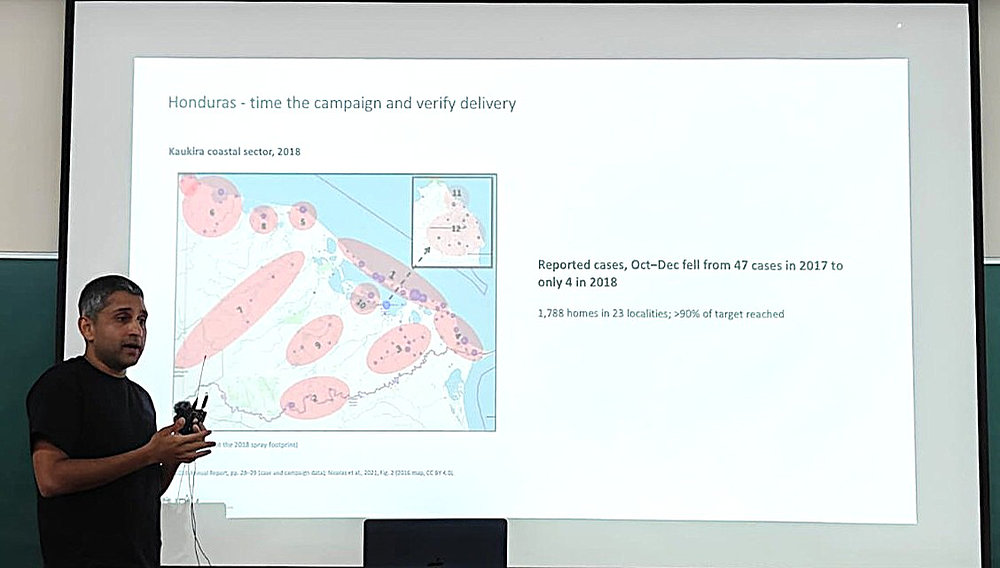
Dr. Selvaraj complemented this with a global view of how vector control strategies are applied in practice, with examples from Honduras, Indonesia, Djibouti, the UAE and Egypt. His central message was that data analytics and quick responses play predominant roles in moving control towards elimination, while transmission modelling has a more specific role in predicting resource needs by integrating past trends. As a region moves towards and beyond elimination, interventions become more targeted and more locally driven.
Together, the two talks offered NDMC's community a timely perspective on how data-driven decision-making can sharpen the final stretch of malaria elimination.